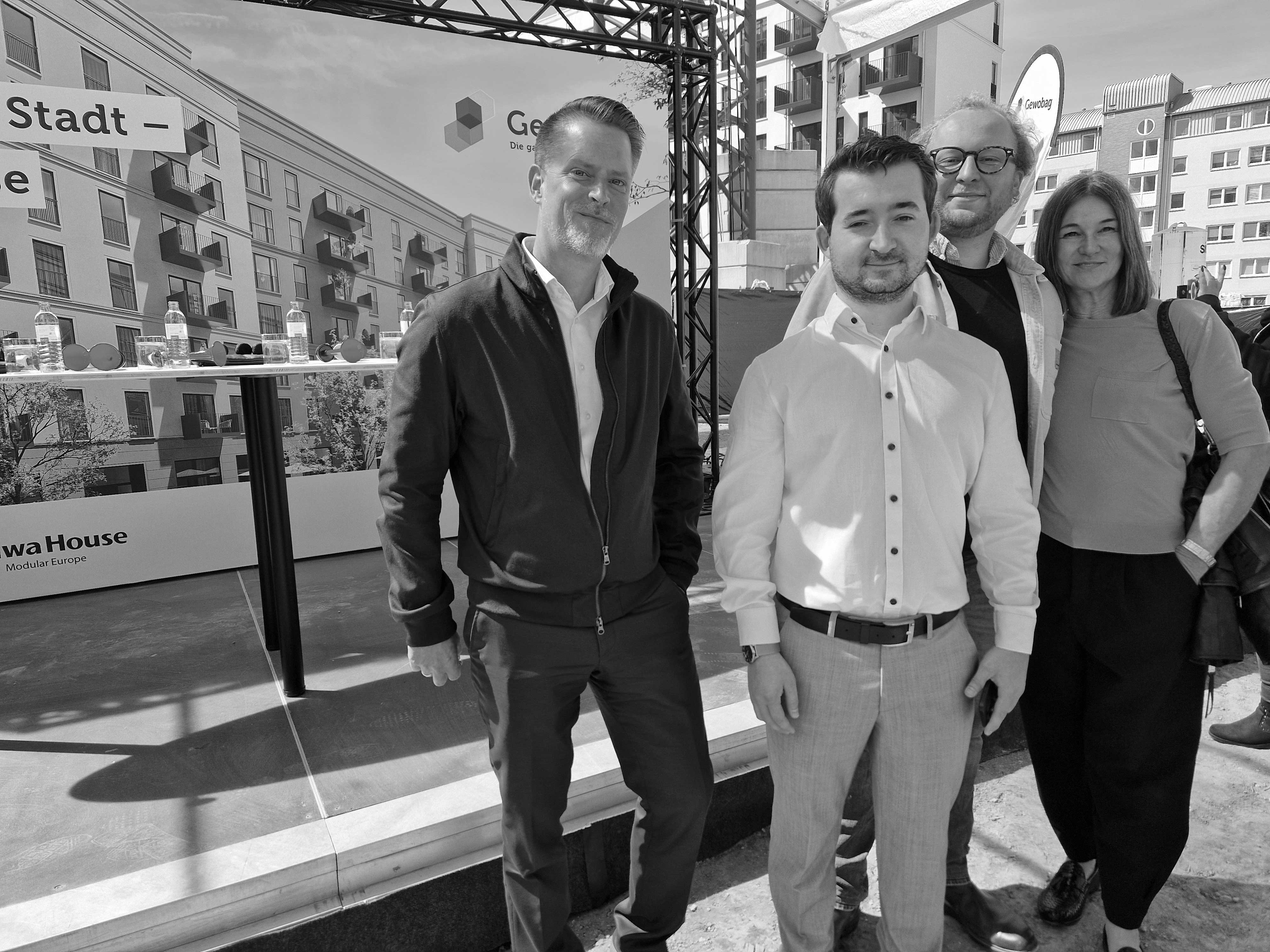
Mit dem Setzen des letzten Moduls wurde an der Landsberger Allee 341–343 ein zentraler Meilenstein für eines der derzeit größten modularen Wohnbauprojekte Berlins erreicht. Die Gewobag realisiert hier ein neues Wohnquartier mit insgesamt 1.548 Wohnungen, ergänzt um eine Kita, Gewerbeflächen, die dazugehörende Infrastruktur und einen öffentlichen Park.
Die Gebäude entstehen in vier Baukörpern in modularer Bauweise. Insgesamt werden über 3.000 Module für Wohnungsgrundrisse unterschiedlichster Typologien gestapelt und vor Ort montiert. Ein einzelnes Modul entspricht im Gewicht etwa „drei Elefanten“, die größten Einheiten bringen bis zu 20 Tonnen auf die Waage.
Das Quartier ist für rund 2.000 bis 2.500 Menschen ausgelegt. Rund 90 Prozent der Wohnungen sind gefördert, ein erheblicher Anteil wird über soziale Wohnraumförderung realisiert.
Die Umsetzung erfolgt durch Daiwa House Modular Europe GmbH, die für das Projekt eigens ein Produktionswerk im brandenburgischen Fürstenwalde errichtet hat. Besonders bemerkenswert: Trotz herausfordernder Rahmenbedingungen in Pandemie, Ukraine-Krise und Zinsumfeld waren sie seinerzeit die einzigen, die für das Projekt einen Festpreis genannt hatten.
Bundesbauministerin Verena Hubertz betonte in diesem Zusammenhang, dass „Bauen weitergedacht“ werden müsse und Förderinstrumente gezielt in solche Projekte fließen sollen. Auch der Regierende Bürgermeister Kai Wegner verwies auf die Bedeutung leistungsfähiger städtischer Wohnungsbaugesellschaften.
Zwei Riegel mit insgesamt 584 Wohnungen werden im September an die Gewobag übergeben.
Ein besonderer Dank an unser Team für Projektsteuerung und Projektleitung: Tobias Rietdorf (interner „Copyright-Inhaber“ des Begriffs Stapelfest), Wolf Körner, André Zeggel, Fynn Reyle und Katja Ahrend.
With the installation of the final module, a key milestone has been reached at Landsberger Allee 341–343 for one of Berlin’s largest modular housing projects currently underway. Gewobag is developing a new residential quarter here comprising a total of 1,548 flats, complemented by a nursery, commercial space, the associated infrastructure and a public park.
The buildings are being constructed as four structures using modular construction methods. In total, over 3,000 modules for a wide variety of flat layouts are being stacked and assembled on site. A single module weighs about as much as “three elephants”, with the largest units tipping the scales at up to 20 tonnes.
The neighbourhood is designed to accommodate around 2,000 to 2,500 people. Around 90 per cent of the flats are subsidised, with a significant proportion being realised through social housing schemes.
The project is being implemented by Daiwa House Modular Europe GmbH, which built a production plant specifically for the project in Fürstenwalde, Brandenburg. Particularly noteworthy: despite challenging conditions caused by the pandemic, the Ukraine crisis and the interest rate environment, they were the only ones at the time to have quoted a fixed price for the project.
In this context, Federal Minister for Construction Verena Hubertz emphasised that “construction must be thought through more thoroughly” and that funding should be channelled specifically into such projects. Governing Mayor Kai Wegner also highlighted the importance of efficient municipal housing associations.
Two blocks comprising a total of 584 flats will be handed over to Gewobag in September.
Special thanks to our project management and project leadership team: Tobias Rietdorf (in-house ‘copyright holder’ of the term ‘Stapelfest’), Wolf Körner, André Zeggel, Fynn Reyle and Katja Ahrend.